Nebraska schools continue to deny transfers for kids with disabilities. Lawmakers gutted a proposed fix.
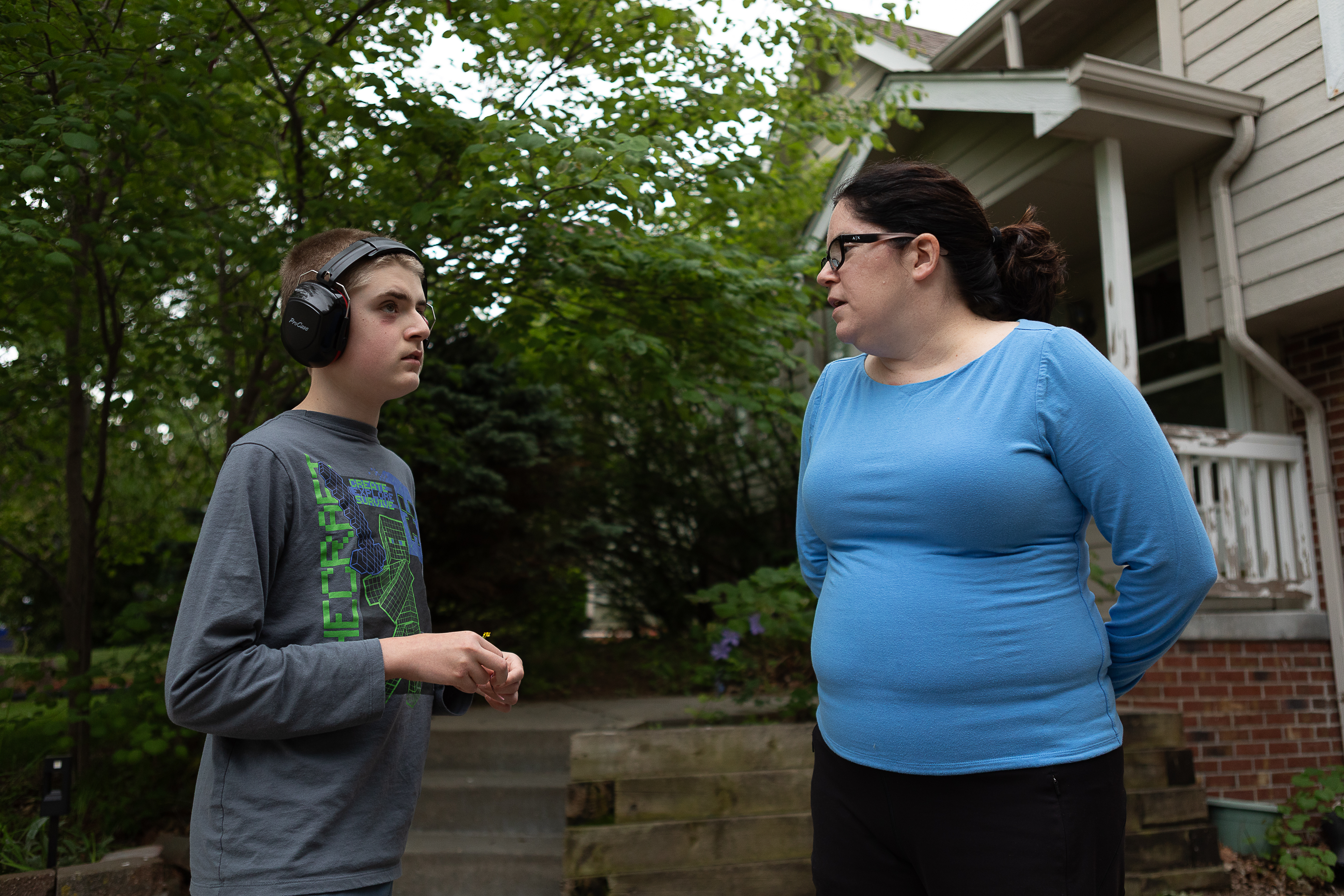
Angela Gleason stands with her son Teddy, then 13, outside of their northwest Omaha home in May 2025. Teddy, who has autism, has been denied transfers several times by suburban school districts. Photo by Liz McCue for the Flatwater Free Press.
Facing opposition, a Nebraska lawmaker pulled his proposed ban on disproportionate transfer denials. Parents and advocates say the resulting legislation will harm the kids it originally aimed to protect.
By Jeremy Turley
Flatwater Free Press
April 22, 2026
For Dave Murman, the issue was personal.
The Republican state lawmaker from Glenvil knew Nebraska school districts were denying transfer requests at high rates to students with disabilities — kids who reminded Murman of his now-grown daughter.
In 2025, he brought a bill to ban the disproportionate rejections.
Gov. Jim Pillen signed the bill last month, but by then, it was unrecognizable to the parents and disability advocates who had once backed it.
Murman, facing opposition from schools and the state teachers union, stripped most of the protections for students with disabilities out of the proposal earlier this year. The new focus of the legislation: Allowing schools to suspend their youngest students.
Angela Gleason, whose son Teddy has been denied transfers several times, said it feels like one step forward and two steps back.
“I was like, ‘Oh, it was going to help kids, and now I feel like it's hurting more kids than it was going to help,’” Gleason said.
The state’s option enrollment policy allows students to transfer from one public school district to another, but in practice, kids with disabilities don’t have the same freedom to transfer as their peers, a 2025 investigation by the Flatwater Free Press and The 74 found.
That trend continued during the 2024-25 school year, according to the latest state report. Nebraska districts denied 35% of option applications from students with individualized education programs (IEPs) compared to about 9% of applications from students without them, a new Flatwater analysis found.
The rejection rates are especially unbalanced in the Omaha suburbs.
Bellevue Public Schools turned away more than three-quarters of students with IEPs but accepted all but one of the 246 applicants without disabilities. The Fort Calhoun, Westside and Douglas County West districts each denied well over half of the kids with IEPs who applied while accepting a majority of kids without IEPs.
Murman’s original bill would have outlawed that. But school administrators and education lobbyists opposed the legislation, contending that districts with dire special ed teaching shortages shouldn’t be forced to take on more kids with IEPs.
The two-term lawmaker knew he didn’t have enough votes from lawmakers willing to buck their local superintendents. So earlier this year, he altered the focus of the legislation.
The amended bill aimed to restore schools’ ability to suspend students in pre-K through second grade for violent behavior, reversing a 2023 ban on the practice.
One option enrollment provision remained: Districts had to guarantee seats for siblings of students who had already optioned in.
After hours of debate on school suspensions, Republican lawmakers passed the bill over objections from Democrats.
The siblings clause will provide an avenue for at least some students with disabilities to get into districts that might otherwise deny them, Murman said.
Sen. Danielle Conrad, a Lincoln Democrat, said Murman hijacked a well-intentioned bill to push Pillen’s priority of removing protections for young students facing punishment.
“If the schools, the Governor and the Legislature won't act to remedy this clear discrimination on a systemic level, I hope parents start suing the schools to hold them accountable,” Conrad said in an email.
Gleason said it’s disappointing that the bill she thought would help kids like her son Teddy transfer schools will result in more of them being suspended.
In first grade, Omaha Public Schools placed Teddy, who has autism, in a general education classroom where he struggled behaviorally, she said. The school called almost daily asking her to pick him up early, she recalled.
“He basically had a lot of informal suspensions where they would call me and ask me to come get him,” Gleason said. “Then he's just missing out on the education, and so it just snowballed.”
Across the state, students enrolled in special education were suspended more than twice as often as their peers last school year, according to state data. The Arc of Nebraska, a leading disability advocacy organization, opposed Murman’s bill because of that disciplinary disparity.
Gleason’s other kids are option students at Millard Public Schools, so Teddy could potentially join them under the new law. It’s still upsetting that the opportunity to transfer doesn’t extend to all other children with IEPs, she said.
For the Shada family, the bill comes years too late to make a difference.
Gary Shada, a longtime teacher at Pierce Public Schools in northeast Nebraska, applied for his daughter Kylee to join the district as an option student, but his employer turned her away.
Kylee, who has Down syndrome, has been enrolled at the nearby Plainview district through middle school — separated from her dad and brother in Pierce. With the elder Shada nearing retirement and his son due to graduate next year, he said he doesn’t see the point in bringing Kylee into the district anymore.
The provision in Murman’s bill allowing siblings to transfer might be a step forward, but the missed opportunity still stings, Gary Shada said. Kylee gets along really well with the kids in Pierce, her father said. He wishes Murman’s bill had been in effect when they first applied for option enrollment.
"I think sometimes public schools forget what their reason for existing is,” Shada said. “It's not about being able to pick and choose who walks through your front door.”
Bellevue Public Schools is short six special ed teachers and about 15 paraprofessionals, and adding more option students with IEPs to “already difficult caseloads is not what is best for teachers or students,” said spokeswoman Amanda Oliver.
“Our decisions are not based on a student’s disability, but on our ability to provide the services required by their IEP in a manner that meets both educational standards and legal obligations,” Oliver said in an email.
Westside Community Schools receives the most option applications in Nebraska, but limitations on staffing and available seats prevent the suburban district from accepting all who apply, spokeswoman Elizabeth Power said.
Grand Island Public Schools, which denied all five of the students with IEPs who applied, is similarly understaffed in special ed and is close to enrollment capacity just with neighborhood students, Superintendent Matt Fisher said in a statement.
“Legally and functionally, we have not been able to accommodate some of the needs of those requesting to enter the district through the option process,” Fisher said.
Staff at the state Department of Education are considering option enrollment rule changes tied to the original and amended versions of Murman’s bill, but it’s not clear what they will look like.
Murman said the disproportionate rejection of kids with disabilities is “pure discrimination.” He is term-limited after this year, but he hopes another lawmaker will take up the cause in the next few years.
Gleason said she appreciated Murman’s intentions, but she’s not hopeful the Legislature will resolve the issue soon, especially given schools’ opposition.
This year, the Legislature also rejected a Democratic proposal that would have required schools to get parents’ approval before changing a student’s IEP. Proponents said the legislation would have given parents a way to fight against schools’ attempts to cut students’ special education services.
Mary Phillips, president of the Arc of Nebraska, takes the long view on advocating for the rights of children with disabilities. It wasn’t until 1975 that a law ensured they could attend their neighborhood schools.
“I feel like progress comes very slow for the disability culture,” Phillips said. “The work isn't done.”
Read the original article
Flatwater Free PressThe Flatwater Free Press is Nebraska’s first independent, nonprofit newsroom focused on investigations and feature stories that matter.
Related Entries

A win for collective advocacy, but the work to protect students is not over
On Monday, Voices for Children in Nebraska, Education Rights Counsel, and ACLU Nebraska joined community members, parents, educators, advocates, and others who spoke up about the use of electrified gloves in Nebraska schools. Our collective voice was heard. Those who raised concerns, shared their experiences, contacted decision-makers, and demanded better for Nebraska students helped make clear that these devices have no place in our schools.
Read More
Voices for Children, Education Rights Counsel, and ACLU of Nebraska issue joint statement on use of electrified gloves in schools.
Voices for Children in Nebraska, Education Rights Counsel, and ACLU of Nebraska stand together in strong opposition to the use of electrified gloves on children in schools and to School Resource Officers carrying these devices in school buildings. There will be an opportunity to share thoughts during time for public comment at the Omaha Public Schools board meeting on Monday, August 17, at 6 p.m. Families in other Omaha-area school districts should also reach out to their school boards to ask about their districts’ policies on use of force and memoranda of understanding with the Omaha Police Department.
Read More
Nebraska schools force kids into seclusion rooms. We don’t know how often it’s happening.
A Lincoln Journal Star investigation reveals that Nebraska schools are repeatedly isolating students with disabilities in seclusion rooms, often with little oversight and no statewide ban, prompting advocates to call for reform.
Read More